Blue Test Diagnostics
Print Blue Test Page
Use this Print blue test page to verify blue brand color coverage with solid blue fill checks for color, density, and alignment before you commit ink, toner, and paper.
Toolkit
Full Colors Test Print Tools
These companion charts support the Print blue test page workflow so you can isolate purple cast from weak cyan, teal cast from weak magenta, and related defects in minutes.
Toolkit
Upload a File for Blue Test Printing
Your file stays on your device. It is not uploaded to our server.
How to Print the Blue Test Page?
Load the correct paper, open a chart on this Print blue test page, and print with the quality preset you use for real blue brand color coverage. If a defect appears, run the matching nozzle or alignment tool, fix one variable, and reprint the same chart. Stop when the new sheet matches your saved Blue Test reference.
Why Use the Blue Test?
A dedicated Print blue test page gives you a controlled way to judge blue brand color coverage before you waste a full job. This page is built around solid blue fill so the defects that matter for blue test work show up on the first sheet instead of halfway through a stack.
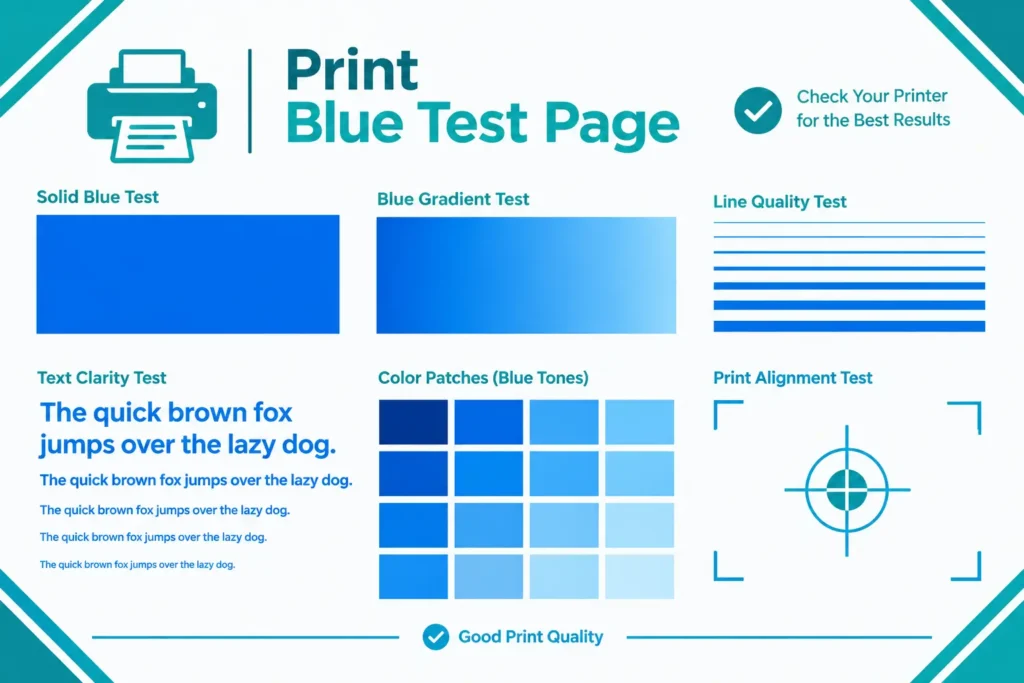
Start with the on-page color, CMYK, and solid tools, then compare the print under bright lighting. Watch especially for purple cast from weak cyan, teal cast from weak magenta, and brand blue fills. Those clues tell you whether to clean nozzles, replace ink or toner, change paper type, or fix a driver preset.
Keep one successful Blue Test sheet as a dated reference next to the printer. When cartridges, media, or software change, reprint and match against that baseline. A short diagnostic habit is cheaper than reprinting finished blue brand color coverage work, and it keeps every teammate judging quality against the same sample.
This content is unique to the Print blue test page draft: the guidance, examples, and checks below are written for Blue Test scenarios rather than copied from the homepage or other paper-size pages.
Blue Test Visual Guide
What Healthy Blue Test Output Looks Like
Healthy Blue Test output looks even, readable, and free of stripes in the areas this page stresses. If only one channel fails, clean or replace that path. If everything is pale, disable Draft/economy mode and confirm the paper type matches what is loaded.
For blue brand color coverage, judge the sheet on the same stock you will use for the real job. A chart that looks fine on plain paper can still fail on coated or heavy media, so match the stock before you approve production.
You can use this blue test page with most printers:
Works on All Printers
Inkjet printers
(Canon, HP, Epson, Brother)
Laser color printers
Built for blue brand color coverage
Tank printers
all-in-one printers
Blue Test Toolkit
Related Blue Test Checks
CMYK for Blue Test
Confirm process-color strength while troubleshooting blue brand color coverage.
Grayscale Check
Verify readable mono output alongside your Blue Test color checks.
Nozzle Pattern
Catch missing jets that create stripes during blue brand color coverage prints.
Head Alignment
Correct doubled edges before approving Blue Test jobs.
Photo Color Grid
Preview image hues after the main Blue Test chart looks correct.
Ink / Toner Cue
Compare expected density with what your supplies deliver on this page.
How to Fix Common Blue Print Problems
- Clean the print head: Use the cleaning tool in your printer software. Do this up to 2 or 3 times.
- Replace low ink: Change any cartridge that is empty or almost empty.
- Align the print head: Run the alignment option from your printer menu.
- Use the printer often: Ink can dry out if you do not print for a long time. Print one color page every week or two to keep it fresh.
- Update the printer driver: An old driver can cause color problems.
How to Read Your Results
Smooth, even blue: Your printer is working well. No action is needed.
White or light lines: The print head may be clogged. Run the “Head Cleaning” option in your printer settings.
Dark and light stripes (banding): The nozzles may be dirty or the ink is low. Clean the print head and print again.
Purple or pink color: The cyan ink may be low or empty. Check your ink levels.
Light or faded blue: The ink may be old or low. Try changing the cartridge.
Spots or smudges: The paper may be wet, or the printer rollers may be dirty. Try a new, dry sheet of paper.
Tips for the Best Results
- Use plain white paper. Colored or damp paper can change the result.
- Check that your ink or toner level is not low before you print.
- Set the paper type correctly in the print settings.
- Do not use “Draft” or “Economy” mode. It uses less ink and gives a lighter print.
- Print the test again after cleaning to see if the problem is fixed.
Print blue test page: Frequently Asked Questions
Unique answers for blue brand color coverage, written for this Print blue test page draft only.
1. What is the Print blue test page?
It is a diagnostic page focused on blue brand color coverage, using solid blue fill style checks so you can catch quality problems before a full run.
2. Why should I use this instead of a generic homepage chart?
This draft is written specifically for Blue Test work, so the examples and failure signs match purple cast from weak cyan and related issues.
3. How do I print from this page?
Click a test button, choose your printer, confirm paper and quality, then print. If the dialog is blocked, use the on-page print control or Ctrl/Cmd + P.
4. Which problem shows up most for Blue Test?
Users commonly report purple cast from weak cyan, along with teal cast from weak magenta. The charts above are chosen to make those defects obvious.
5. What should I do if the first print fails?
Note which color or area failed, clean or adjust only that part of the workflow, then reprint this same Print blue test page for a before/after comparison.
6. Does paper choice matter here?
Yes. Use the same media planned for your blue brand color coverage job so density, drying, and color shift match production.
7. Will this work on inkjet and laser printers?
Yes. Inkjet users will see nozzle and ink density clues; laser users will see toner density, scatter, and registration clues on the same structured layout.
8. How often should I reprint the Blue Test?
After supply changes, cleaning cycles, driver or preset changes, and whenever new output no longer matches your saved reference sheet.
9. Can I upload my own file on this page?
Yes. After the standard charts look healthy, use the upload tool to proof a real blue brand color coverage file on the same printer settings.
10. Is this Print blue test page free to use?
Yes. The tools stay free in the browser with no account required for these diagnostic prints.